
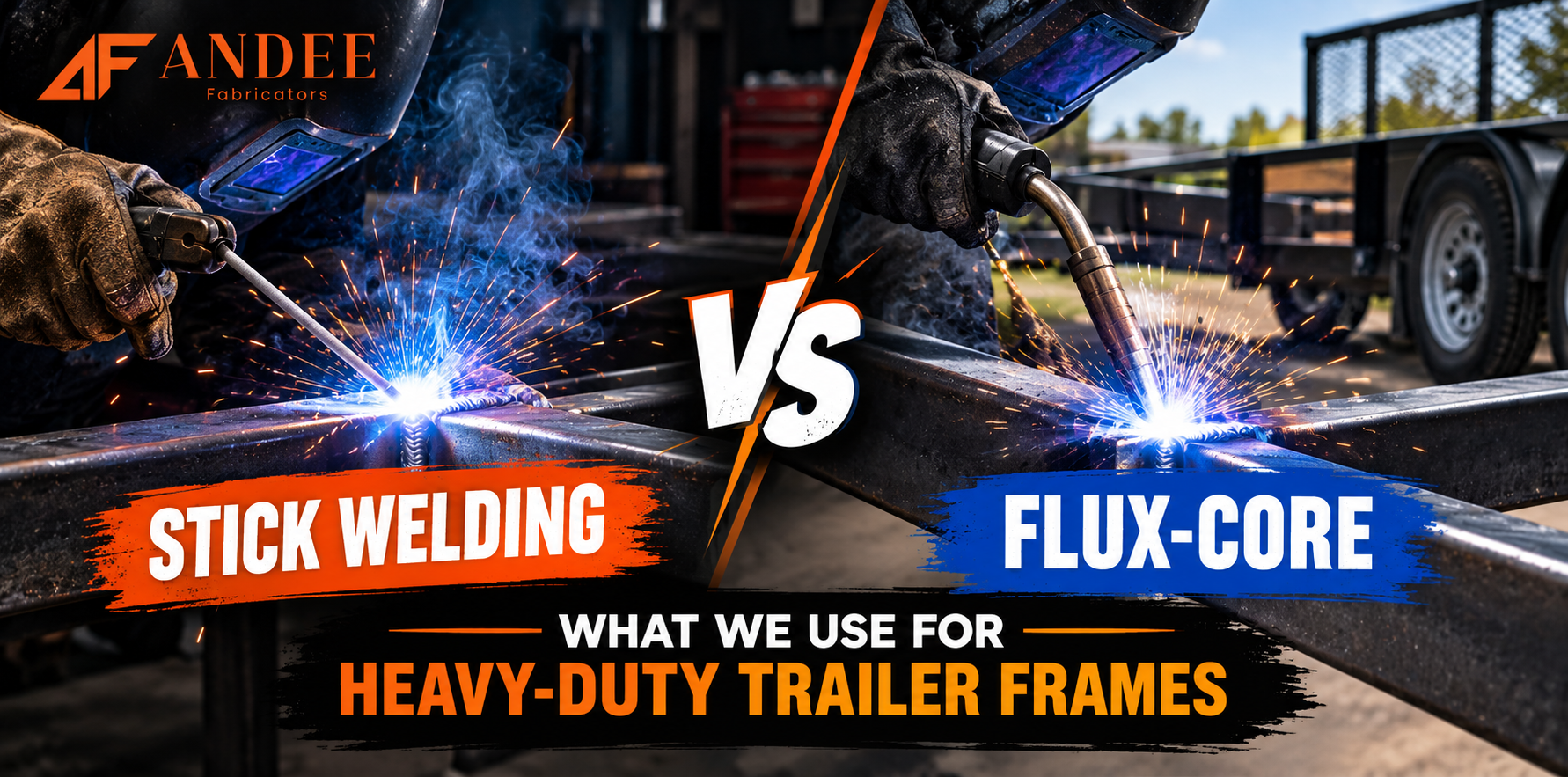
Stick Welding vs Flux-Core: What We Use for Heavy-Duty Trailer Frames
If you’re researching trailer fabrication or planning to get a custom trailer built, you’ve probably come across two terms that keep showing up: Stick Welding (SMAW) and Flux-Core Welding (FCAW). Both are strong, reliable processes — but they’re not interchangeable, and the choice matters a lot when you’re talking about something that needs to survive years of load, vibration, and rough roads: a trailer frame.
At Andee Fabricators, we get asked this question a lot by customers who want to understand why we build frames the way we do. Here’s everything you should know before your next search — or your next custom fabrication order.
What Is Stick Welding (SMAW)?
Stick welding, technically called Shielded Metal Arc Welding (SMAW), uses a flux-coated electrode rod that melts as it welds. The flux coating burns off and creates a gas shield that protects the weld pool from contamination — no external gas tank required.
Strengths:
- Works well outdoors, even in wind — no shielding gas to blow away
- Handles rust, dirt, and paint on the metal surface better than most processes
- Excellent penetration on thick steel
- Simple, portable equipment
Limitations:
- Slower than wire-fed processes
- Leaves slag that needs to be chipped off after each weld
- Requires more operator skill to get consistent results
- Not ideal for thin sheet metal (can burn through)
What Is Flux-Core Welding (FCAW)?
Flux-Core Arc Welding is a wire-feed process, similar to MIG welding, but the wire itself has a flux core instead of relying on an external shielding gas (in the self-shielded version). It’s essentially designed to combine the outdoor-friendliness of stick welding with the speed of wire feeding.
Strengths:
- Much faster than stick welding — continuous wire feed instead of stopping to change rods
- Deep penetration, good for thick structural steel
- Works well outdoors and in windy or drafty conditions (self-shielded FCAW)
- Easier for semi-skilled welders to produce consistent beads
Limitations:
- More spatter than other processes
- Slag removal still needed (though less than stick in most cases)
- Not as clean-looking as TIG or gas-shielded MIG
- Fumes are heavier, so ventilation matters more indoors
So Which One Is Better for Trailer Frames?
Here’s the honest answer: both have a place, but for heavy-duty trailer frames specifically, flux-core tends to win on production jobs, while stick welding remains the go-to for repairs, thick cross-members, and field conditions.
| Factor | Stick Welding | Flux-Core |
| Speed | Slower | Faster |
| Outdoor performance | Excellent | Excellent |
| Penetration on thick steel | Very strong | Strong |
| Consistency at scale | Depends on welder skill | More consistent |
| Best use case | Repairs, thick joints, rough surfaces | Frame assembly, production runs |
For a full trailer chassis build, where we’re joining structural steel members that need to handle constant flex and load-bearing stress, flux-core gives us the speed and penetration to get strong, repeatable welds across the whole frame. When it comes to repairing an old, rusted, or damaged frame — especially on-site or in less controlled conditions — stick welding often does a better job because it’s more forgiving of imperfect surfaces.
What This Means for You as a Customer
If you’re getting a trailer built or repaired, you don’t need to know how to weld — but knowing why a fabricator chooses one process over another tells you a lot about build quality. A shop that understands when to use stick vs. flux-core (rather than defaulting to whichever machine is closest) is a shop that’s thinking about the long-term durability of your frame, not just getting the job done fast.
Questions worth asking your fabricator:
- What welding process will be used on the main frame joints?
- How is the weld cleaned and inspected afterward?
- Is the steel prepped (cleaned, rust-free) before welding, or welded over as-is?
FAQs
1. Is flux-core welding as strong as stick welding?
Yes — for structural steel like trailer frames, flux-core welding offers penetration comparable to stick welding, especially on thicker sections. The strength difference mainly comes down to technique and joint preparation, not the process itself.
2. Can flux-core welding be done outdoors?
Yes, self-shielded flux-core (FCAW-S) is designed for outdoor use and performs well in windy conditions, similar to stick welding — unlike gas-shielded MIG, which is more wind-sensitive.
3. Why not just use MIG welding for trailer frames?
Standard gas-shielded MIG welding is fast and clean but needs a controlled environment and shielding gas, which isn’t always practical for thick structural steel or outdoor fabrication work. Stick and flux-core handle these conditions more reliably.
4. How do I know which welding process my trailer repair needs?
It depends on the steel thickness, surface condition (rust, paint, old welds), and whether the work is done in a shop or on-site. A good fabricator will assess this rather than using one process for everything — this is something you can simply ask about when getting a quote.
The Bottom Line
Stick welding and flux-core welding aren’t competitors — they’re tools for different jobs. At Andee Fabricators, we choose the process based on the steel thickness, the working environment, and the purpose of the build, whether that’s a new trailer frame, a steel rack, or a repair job. That’s the difference between a weld that holds for a season and one that holds for years.