
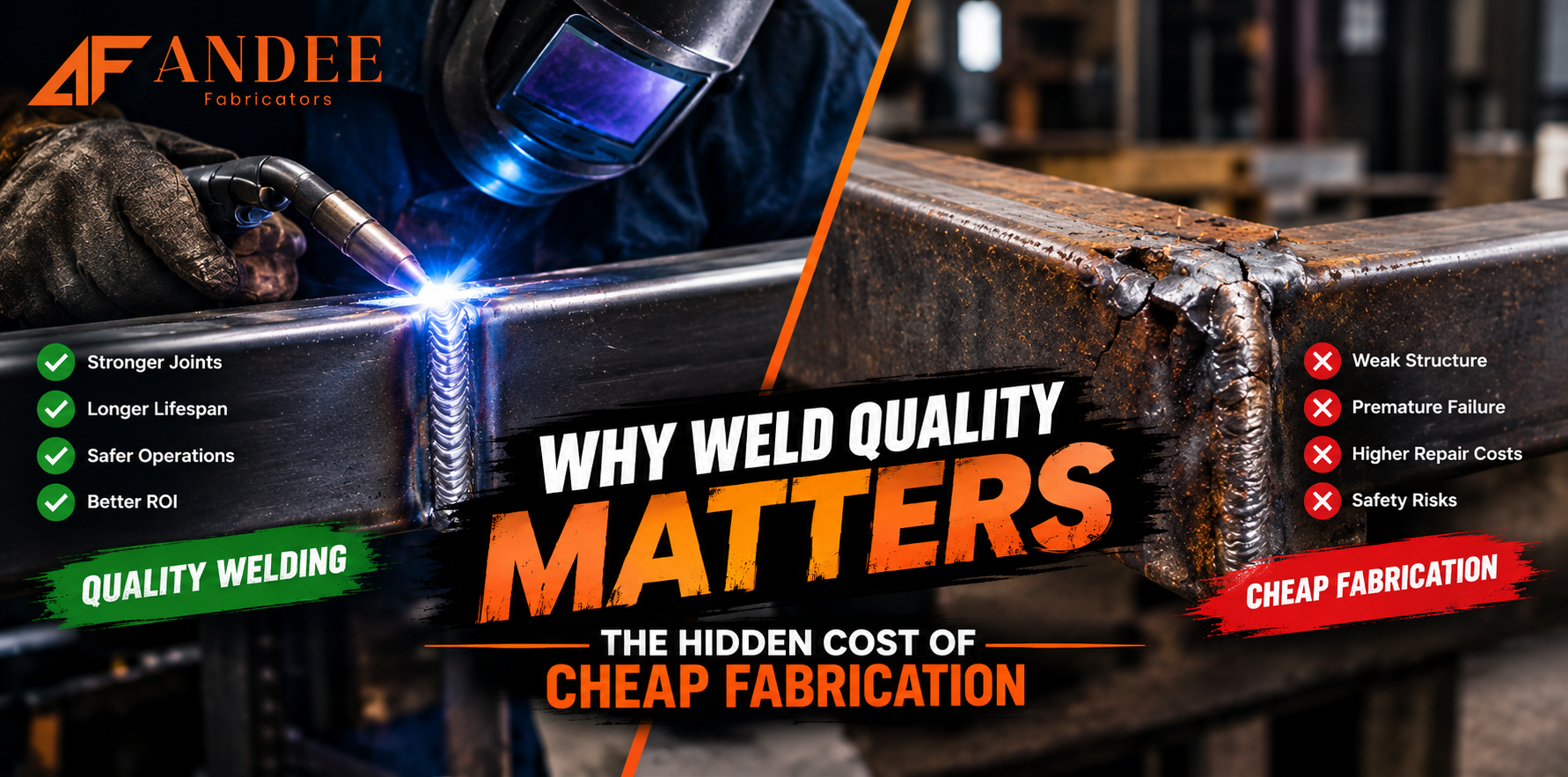
Why Weld Quality Matters: The Hidden Cost of Cheap Fabrication
When you’re comparing fabrication quotes, it’s tempting to go with the lowest number on the page. But a weld isn’t just a joint between two pieces of metal — it’s the single point where the structural integrity of your entire project lives or dies. Cheap welding doesn’t just risk a weaker product; it risks safety, downtime, and money you’ll end up spending twice.
What Makes a Weld “Cheap” vs. “Quality”
Not all welds are created equal, even when they look similar on the surface.
- Cheap welds are often rushed, use lower-grade filler material, skip proper joint preparation, and are done by undertrained operators without consistent quality checks.
- Quality welds involve correct heat control, proper penetration, certified welders, and inspection at every stage — from material selection to the final bead.
The difference is rarely visible to the untrained eye. That’s exactly what makes it dangerous.
Who Feels the Impact of Poor Weld Quality
- Business owners — footing the bill for repairs, replacements, or liability claims
- End users — operating equipment or structures that may fail under stress
- Fabrication shops — facing reputational damage and lost repeat business
- Site workers — exposed to real safety risk when structural welds fail
Why Weld Failures Happen
- Inadequate joint preparation — skipping cleaning or beveling steps to save time
- Wrong filler material — using cheaper alloys not rated for the application
- Inconsistent heat control — causing brittleness, cracking, or warping
- Untrained or uncertified welders — lacking the skill to read and adjust for material behavior
- No inspection process — defects go undetected until the part is under load
When Weld Quality Problems Show Up
Weld defects don’t always fail immediately — that’s the hidden part of the “hidden cost.”
- Immediately: visible cracking, poor fusion, or failure under initial load testing
- Weeks to months later: fatigue cracking under repeated stress or vibration
- Years later: corrosion starting at a weak weld point, eventually causing structural failure
By the time the problem is visible, the cost of fixing it is often far higher than the original savings.
How Cheap Fabrication Costs More in the Long Run
| Cost Type | Cheap Fabrication | Quality Fabrication |
| Upfront price | Lower | Higher |
| Rework/repair costs | High, recurring | Minimal |
| Downtime | Frequent | Rare |
| Safety liability | Elevated | Reduced |
| Lifespan of the piece | Shorter | Significantly longer |
How to Evaluate Weld Quality Before You Buy
- Ask whether welders are certified (e.g., AWS or equivalent standards)
- Request examples of past work with similar load or stress requirements
- Check whether the shop does its own quality inspection or third-party testing
- Look at weld bead consistency — uniform ripples usually indicate steady technique
- Ask what filler material and process (MIG, TIG, stick) is being used and why
FAQs
Q: Can you tell if a weld is low quality just by looking at it?
A: Sometimes — inconsistent bead patterns, spatter, or visible cracks are red flags. But many defects, like poor penetration, are only detectable through testing or X-ray inspection.
Q: Is a more expensive fabricator always better?
A: Not necessarily, but price alone shouldn’t be the deciding factor. Certifications, process transparency, and inspection standards matter more than the quote.
Q: How long should a properly welded structure last?
A: With correct technique and material selection, structural welds can outlast the equipment or structure itself — often decades — with minimal maintenance.
Q: What’s the biggest hidden cost of cheap welding?
A: Downtime and liability. A failed weld on load-bearing equipment can halt operations entirely or create serious safety and legal exposure.
The bottom line: the cheapest quote rarely stays the cheapest option. When it comes to fabrication, weld quality is the foundation everything else is built on — literally.